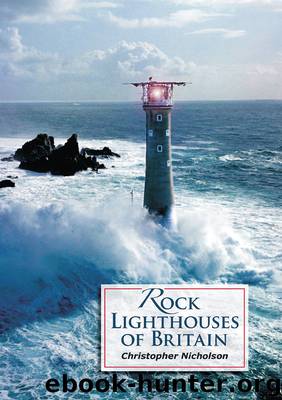
Rock Lighthouses of Britain by Christopher Nicholson
Author:Christopher Nicholson
Language: eng
Format: epub
Publisher: Whittles Publishing
If it be remembered that we were at the mercy of wind and waves of the wide Atlantic and were every day in the expectation of a sudden call to leave the rock and betake ourselves to the vessel, and on several occasions had our cranes and other tools swept into the sea, the slowness of our progress will excite less surprise.
By the end of the season the base was almost ready to receive blocks, an operation which would now have to wait until the following year. Stevenson had spent two seasons on Skerryvore and had not yet landed a block, only wood and metal stood on the reef. During the close season much activity was in progress away from the site. Between April 1839 and June 1840 quarries on Mull echoed to the sound of repeated blasting that yielded over 4,300 blocks from the island. These were roughly shaped, despatched to Hynish, where gangs of masons hammered and chiselled them to a shape determined by a template so that little extra work would be required when on the reef. The stones varied from ¾ ton to 2½ tons in weight, and could occupy anything from 85 to 320 hours of a man’s time in shaping them to the degree of precision necessary.
Hynish, too, was bustling with activity. Not only were the blocks being shaped and fitted, but a harbour and pier were under construction. More accommodation was built to house the swelling numbers before construction of the lighthouse could begin in earnest.
The morning of 30th April 1840 was the start of the year’s operations. The barrack, much to the relief of the engineer, had survived the winter’s gales and was ready for occupation once more. By 20th June the first stones were arriving at the reef on board the appropriately named Skerryvore which was duly bedecked with flags for the occasion. The first stone was laid on 4th July 1840 by John, the seventh Duke of Argyll, from whose quarries the stone was being hewn. His visit on that day made an impression on his mind which could not be erased by the passage of time.
Download
This site does not store any files on its server. We only index and link to content provided by other sites. Please contact the content providers to delete copyright contents if any and email us, we'll remove relevant links or contents immediately.
Whiskies Galore by Ian Buxton(42088)
Introduction to Aircraft Design (Cambridge Aerospace Series) by John P. Fielding(33180)
Small Unmanned Fixed-wing Aircraft Design by Andrew J. Keane Andras Sobester James P. Scanlan & András Sóbester & James P. Scanlan(32836)
Aircraft Design of WWII: A Sketchbook by Lockheed Aircraft Corporation(32336)
Craft Beer for the Homebrewer by Michael Agnew(18289)
Turbulence by E. J. Noyes(8130)
The Complete Stick Figure Physics Tutorials by Allen Sarah(7427)
The Institute by Stephen King(7095)
The Thirst by Nesbo Jo(7012)
Kaplan MCAT General Chemistry Review by Kaplan(6991)
Bad Blood by John Carreyrou(6675)
Modelling of Convective Heat and Mass Transfer in Rotating Flows by Igor V. Shevchuk(6496)
Weapons of Math Destruction by Cathy O'Neil(6371)
Learning SQL by Alan Beaulieu(6349)
Man-made Catastrophes and Risk Information Concealment by Dmitry Chernov & Didier Sornette(6144)
Permanent Record by Edward Snowden(5907)
Digital Minimalism by Cal Newport;(5842)
Life 3.0: Being Human in the Age of Artificial Intelligence by Tegmark Max(5621)
iGen by Jean M. Twenge(5467)
